Camino de Santiago

Prepare your Camino de Santiago de Compostela here:

Find more videos like this on Camino de Santiago Albergue

Welcome

On this site you will find all you need to know about the Camino de Santiago. We have thousands of visitors a month, many of them answering questions that a “soon-to-be-pilgrim” might have.

This site is basically split in two parts:
1) Camino de Santiago Albergue, it’s like Facebook for pilgrims.
2) Camino de Santiago Forum, share and learn about the Camino de Santiago.

The albergue is a Social Network while the Forum is regular forum. Both places is an excellent way of finding answers to your camino question. A good start is to use the search box below. Chances are that someone has already asked your question and that you will find the answer just by searching.

Camino Question? Search and you shall find:

(Use the search box below)

Loading


Meet old and new pilgrims over at one of our many groups in the “Albergue”:

United States of America
USA Pilgrims
: A group for Americans headed to the camino in summer 2010.

Poland
Pilgrims from Poland: Group for all polish pilgrims and pilgrims from other countries walking polish Camino trails.

Germany
Pilgrims from Germany
: A group for german pilgrims and about german pilgrim trails.

NorwayFinlandDenmarkSweden
Scandinavians on the Camino
: Møt skandinaver som har tenkt seg sydover til Spania for å gå Caminoen.

New ZealandAustralia
Anzac Corner
: A place for those from Australia and New Zealand to hang out and share Camino info.

More groups here… Can not find your country/group? Create a group here


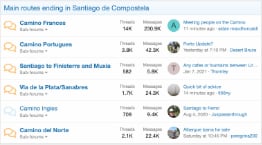
The Way of St. James extends from all corners of Europe, and even North Africa, on its way to Santiago de Compostela and Finisterre. The local authorities try to restore many of the ancient routes, even those used in a limited period, in the interest of tourism. Here follows an overview of the main routes of the modern-day pilgrimage.

The pilgrimage to the shrine of the apostle James the Great – Santiago in Spanish – developed into one of the most important Christian pilgrimages in medieval times after the claimed discovery in the 9th century of the apostle’s burial site in what later became Santiago de Compostela.

According to the legends later compiled in the 12th-century Codex Calixtinus, St James’ remains were carried by boat from Jerusalem to northern Spain where they were buried on the site of what is now the city of Santiago de Compostela.

Camino Francés

is the most popular of the routes of the Way of Saint James, the ancient pilgrimage route to Santiago de Compostela in Spain. It runs from Saint-Jean-Pied-de-Port on the French side of the Pyrenees to Roncesvalles on the Spanish side and then another 780km on to Santiago de Compostela through the major cities of Pamplona, Logroño, Burgos and Léon.By far the most used route to Santiago. Some say that it’s a good first camino to walk due to the fact that you will not walk alone and that the way markings are quite good. It can get busy in the summer months, especially towards the last few days. To get the compostela (the diploma) you will need to walk the last 100km. Sarria is located about 110km from Santiago de Compostela, making it a popular starting point. The most popular starting point in France, is Saint Jean Pied de Port on the other side of the Pyrenees.

Camino Frances

Camino Portugués

Camino PortugueseThe Portuguese route has its name because of the starting point of this route. The route comes in to Santiago from the south with pilgrims from as far as Porto or even Lisboa. This route has less pilgrims than the the French route, and has become a strong alternative for pilgrims wanting to walk a different route. Pilgrims travel north crossing the Lima and Minho rivers before entering Spain and then on to Padron before arriving at Santiago. It is the second most important way, after the french one. 227 km long. A popular start point for a 108 km walk to Santiago is at Valença, Portugal, by the Spanish border, through Tui, Galicia.

Camino del Norte

runs from France at Irún and follows the northern coastline of Spain to Galicia where it heads inland towards Santiago joining the Camino Francés at Arzúa. This route follows the old Roman road, the Via Agrippa, for some of its way and is part of the Coastal Route (Spanish: Ruta de la Costa). The route passes through San Sebastian, Guernika, Bilbao, and Oviedo. It is less populated, lesser known and generally more difficult hiking. When walking it, as opposed to seeing albuergues or monasteries every four to ten kilometers as on the Camino Frances, shelters will be between 20 and 35 kilometers apart.

Camino Inglés

is traditionally for pilgrims who traveled to Spain by sea and disembarked in Ferrol or A Coruña. These pilgrims then made their way to Santiago overland. It is so called because most of these pilgrims were English though some come from all points in northern Europe.
camino ingles
Although the Galician coast is generally so hostile to shipping that’s it’s known as the Costa da Morte – the Death Coast – it does contain some good natural harbours in the various rías, the flooded valley estuaries that indent the coast. Once Santiago’s fame started to spread, ships carrying pilgrims from ports further north on the Atlantic seaboard started to arrive in these natural harbours.

On the north coast, none is better than the large natural harbour formed jointly by the rías of Corunna, Betanzos, Ares and Ferrol, known collectively to the Romans as the Magnus Portus Artabrorum. The main Roman town in the area was Brigantium – there is some dispute whether this was Corunna or Betanzos – and they built a lighthouse at Corunna, which still functions and is known as the Torre de Hercules – Tower of Hercules. The pilgrim ships used a variety of landing places in the rías, but as Corunna grew in importance, it became preeminent among them.

Because English pilgrims were an important proportion of those using this route, it is known as the Camino Inglés, but English were by no means the only ones to use it. Ships from other parts of Britain, from Ireland, France, the Low Countries, Scandinavia, even N Germany and the Baltic, are all recorded as sailing to Galicia. Whereas there are few records of the exact overland routes medieval pilgrims took, because ships often had to be licensed to carry pilgrims, the sea voyages are relatively well documented.

What to Bring with you on your WalkCamino de Santiago poncho

There are probably as many packlists as there are pilgrims, but for those of you that are looking for a place to start, here is a place to start.  Please feel free to add your collection of items as well.

Weight is as always with long distance trekking the crucial factor. With a light rucksack (under 1 kilo, Deuter AC series, Golite Dawn, Jam or Gust) and modern lightweight trekking clothes you could carry a 1 Kilo tent (Mountain Equipment AR Ultralight, Terra Nova Argon, Coleman Raid, trust me a quiet night without snoring pilgrims around you is worth the weight!), a mat to sleep on (essential emergency bed in high season, thermarest prolite 3 is lightest) and cooking kit (only useful on the quiet routes or out of season) and still carry less than 6 kilos. Carrying less means less strain on your body, less blisters, less injuries, more distance covered each day and so less of your pilgrimage will be concerned with dealing with physical problems, and more attention can be given to that spiritual stuff!. Or if you have other motivations, a small light pack will make you the envy of your new friends! Have a look at this sample Packlist.